You are here
Orchestral Wizardry and Russian Folk Music
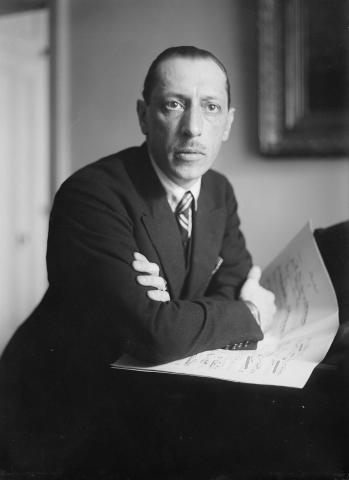
Igor Stravinsky (1882–1971) was a Russian composer and conductor with French and American citizenship. He is widely considered one of the most important and influential composers of the 20th century and a pivotal figure in modernist music.
Born into a musical family in Saint Petersburg, Stravinsky grew up studying piano. While studying law at the University of Saint Petersburg, he met Nikolai Rimsky-Korsakov and studied music under him until the latter's death in 1908. Soon after, Stravinsky met ballet impresario Sergei Diaghilev, who took a chance on the young Stravinsky, who was only in his 20s, by commissioning him to write the ballet The Firebird for the Ballets Russes in 1910. Diaghilev would later commission Stravinsky to write Petrushka (1911) and The Rite of Spring (1913).
The Firebird story tells of the downfall of a powerful, ogre-like figure of evil, Kastchei the Deathless, who seizes young princesses as captives and turns the knights who arrive to rescue them to stone. The protagonist Crown Prince Ivan enlists the Firebird, so called for her beautiful feathers that glitter and flicker like flames, to help destroy Kastchei and free his victims.
A resounding success at its Paris premiere, Suite from The Firebird remained one of Stravinsky's most popular works for half a century. It blends the orchestral wizardry Stravinsky learned as a student of Rimsky-Korsakov with the vitality of Russian folk music, yielding a dazzling, evocative atmosphere. Like a fantasy story told through music, the suite features a "spooky" opening, the magical dance of the Firebird, the graceful "Round Dance of the Princesses," and the chaotic, high-energy "Infernal Dance."