You are here
October 2026 Concert
The musical world will celebrate Ludwig van Beethoven in 2027 during the 200th anniversary of his death. The ESO presents our own tribute with three well-known works that demonstrate the breadth of Beethoven’s genius. The program begins with the overture to Fidelio. Then, ESO favorite Irina Muresanu returns to the ESO to play Beethoven’s lyrical, expansive, and expressive Violin Concerto, one of the most-performed and popular works in the repertoire. The program concludes with the composer’s 5th Symphony with its iconic four-note opening — perhaps the most famous symphony of all time — a transcendent masterpiece, balancing symphonic grandeur with intense rhythmic drive.
Program
Musical Insights Free Pre-Concert Preview the Friday before this concert.
Learn How to Attend!
- Beethoven
- Fidelio Overture
- Beethoven
- Violin Concerto
Irina Muresanu, violin
- Beethoven
- Symphony No. 5
Sponsored by
Anonymous
Pick-Staiger Concert Hall
50 Arts Circle Drive, Evanston
See map.
TICKETS
Buy TicketsAll tickets are assigned seating.
Please call 847-864-8804 for wheelchair accessible tickets.
Advance Sales
$42 Adult, $36 Seniors, $5.00 Full-Time Student
At the Door Sales
$47 Adult, $41 Seniors, $5.00 Full-Time Student
Children Free
Children 12 and younger are admitted absolutely FREE, but must have an assigned seat.
Please call 847.864.8804 or email tickets@evanstonsymphony.org for all orders with children’s tickets.
Soloist
Irina Muresanu, violin
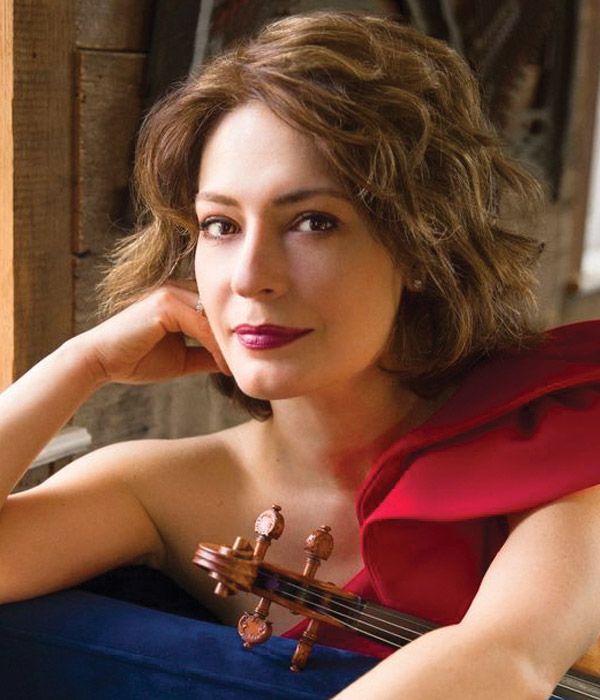
What a joy it is to welcome Irina Muresanu back to our stage for the seventh time — and each time finds her involved in something new and exciting! She first appeared with the ESO in 2007, performing Brahms’ Concerto for Violin and Orchestra in D Major before an enthusiastic audience. At the same time, she was teaching at Boston Conservatory, New England Conservatory and MIT, was part of three ensembles-in-residence, was traveling for concert appearances, recorded an album, and was working on her doctorate.
Maestro Eckerling was extremely impressed by Irina’s performance and promised himself he’d invite her back. He’s kept that promise. In 2010, she returned to perform Tchaikovsky’s Concerto for Violin and Orchestra in D Major. (Still teaching in Boston, traveling to perform, and welcomed son Victor. Naps became a luxury.) In 2013, Dvořák’s Concerto for Violin and Orchestra in A Minor. (More of same plus faculty at prominent music festivals and programs.) In 2016, she performed Brahms’ Concerto for Violin, Cello and Orchestra in A minor and Dvořák’s Slavonic Dance No. 2 in E minor with another ESO favorite, cellist Wendy Warner. (Newly appointed Assistant Professor of Violin and Chamber Music at the University of Maryland. More of everything. Performing everywhere.)
Three seasons later, Irina came to Evanston to perform Prokofiev’s Concerto for Violin in G minor and had rehearsed with the orchestra on Tuesday evening. A pleasant walk on Thursday was interrupted by a phone call. Maestro Eckerling. Sunday’s concert was canceled. It seems a pandemic was rising… Irina and her family packed for three weeks and retreated to Maine; they stayed for six months. No live concerts, but regular, innovative performances online. She taught her students remotely and also recorded all of the standard études, the exercises all violinists must learn to make the basics part of their bones. This led to an idea: an AI platform to give students more support when practicing the études on their own. In July 2021, Irina and a colleague received the prestigious Maryland Innovation Initiative Award for their collaborative research in developing AI technology for use in violin pedagogy. They called the platform “vAIolin.”
Post-pandemic, 2023 brought Irina back to the ESO for Prokofiev’s Violin Concerto No. 2. Another stellar performance. (Now an Associate Professor. More teaching. More travel. More collaborations. Fewer naps.)
And here we are in 2026, for Irina’s performance of Beethoven’s lyrical Violin Concerto. She’s now a full Professor at Maryland and Affiliate Faculty at both Maryland’s Institute for Advanced Computer Studies and its Artificial Intelligence Interdisciplinary Institute. She’s still teaching, traveling, performing, mentoring, innovating, and has also been conducting. And during all this time, she’s created an impressive discography, with her 2018 solo album, Four Strings Around the World, receiving critical acclaim. In addition, there’s a long list of awards, including one from the University of Maryland for “Infinite Strings,” a platform designed to promote violin music by Romanian composers.
—Kelly Brest van Kempen
Musical Insights
Free Pre-Concert Preview Series!
October 16, Friday, at 1:30 pm

Enhance your concert experience with a sneak preview — Composers come alive and their passions take center stage when ESO Maestro Lawrence Eckerling takes you on an insider’s tour of the history and highlights behind the music.
Irina Muresanu and Larry Eckerling will be playing the first movement from Beethoven's Spring Sonata No. 5 at Musical Insights.
Friday, October 16 at 1:30 pm,
Merion’s Crystal Ballroom at
529 Davis St, Evanston.
FREE and open to the public.
Please RSVP to 847-570-7815.

Light refreshments will be served and casual tours of apartments will be available after the program.
Program Book
Program Notes
Overture to Fidelio, Op. 72
Ludwig van Beethoven (1770–1827) 6 minutes (1814)
Nothing else in Beethoven’s career caused as much effort and heartbreak as the composition of his only opera, which took ten years, inspired four different overtures, and underwent two major revisions and a name change before convincing Beethoven that he was not a man of the theater.
The history of the four overtures to Fidelio — or Leonore, the title Beethoven originally chose and always preferred — is nearly as complicated as that of the opera itself. Their sequence is further confused by the numbers mistakenly given to them after the fact, so that Beethoven’s first effort is now known as Leonore no. 2 and his second as no. 3. (An overture written for a production in Prague that never took place was discovered after Beethoven's death, mistaken for his earliest effort, and called Leonore no. 1, thereby setting up this entire series of wrong numbers.) The Fidelio Overture performed at these concerts is Beethoven’s final word on the subject.
Both of Beethoven’s first efforts — Leonore overtures nos. 2 and 3 — are highly impressive works, but each made the mistake of providing too much music for the task at hand, which was, after all, simply to quiet the crowd, raise the curtain, and set the stage for the drama to follow. Instead, both of these two overtures presented a drama all its own.
In 1814, the Kärntnertor Theater wanted to mount a revival of Fidelio, prompted by a “sudden and boundless popularity of Beethoven’s music,” in the words of Alexander Thayer, the composer’s biographer. (Half of the public concerts held for the composer’s benefit in his lifetime were given that year.) In 1814, with Napoleon just defeated, the opera took on fresh meaning, as it has continued to do ever since, as each age reads this work in light of the reports of tyranny and acts of heroism in the current headlines. Beethoven jumped at the chance to revise the score — he warned the management that there would be many changes — and to write yet another overture. As it turned out, he could not finish the overture in time for the opening, and so the overture to Fidelio, as it is known today, was actually premiered at the second performance.
With his final attempt at composing music to open his opera, Beethoven found an ideal solution — the overture to Fidelio is shorter and lighter than either of the two Leonore overtures, and it leads to the opera’s first number, rather than upstaging it (it also is in E major, the dominant of the opera’s first key, while the Leonore overtures are in C major, the opera’s final tonal destination). The Fidelio overture may be less important as stand-alone music, but it is perfect stagecraft. Fidelio was at last a public success, and Beethoven felt momentarily vindicated, although after all he had been through, he could not be blamed for complaining that “this whole opera business is the most tiresome affair in the world.”
— Program note by Phillip Huscher, program annotator for the Chicago Symphony Orchestra.
Reprinted with permission © 2026 Chicago Symphony Orchestra Association
Concerto for Violin and Orchestra, Op. 61
Ludwig van Beethoven (1770–1827) 42 minutes (1806)
When he composed his only violin concerto, Beethoven was permanently settled in Vienna, where several aristocrats recognized his genius and provided financial support.
They also were able to overlook his prickly personality and his extraordinary independence and accomplish delicate negotiations on his behalf. This great concerto belongs to a very fertile period in his life, during which he turned out one masterpiece after another. This happened despite Napoleon’s arrival in Vienna, which disrupted everything. Beethoven also was trying to adjust to his increasing deafness during this period. He composed the Violin Concerto for Franz Clement, who was appointed first violinist and director at the new Theater an der Wien at the age of 22. He had directed the first public performance of the ground-breaking Symphony #3 — the “Eroica.”
Like the Symphony, the Violin Concerto is much longer than the classical works the public was used to. One critic points out that the first movement of the Concerto is longer than an entire classical concerto! The experts are not unanimous as to the details of its composition, although apparently Beethoven wrote it in some haste.
But the story goes that Clement played it with no previous rehearsal. This is doubtful since it appears that he worked with Beethoven on the solo violin part at least.
Although this concerto stands at the pinnacle of violin literature, it was not well received at its premiere in 1806. It is remarkably symphonic in its conception.
Five hushed beats in the tympani are followed by statements of both main melodies in the magnificent introduction. The violin’s entrance leads to an intricate development, the soloist collaborating closely with the orchestra.
The gravely simple larghetto is built around two themes, delicately embellished by the soloist. Without pause, the playful violin launches the rondo theme and later introduces the minor, contrasting melody. The Concerto concludes in a brilliant coda.
— Program note by Lilias Circle
Symphony No. 5 in C Minor, Op. 67
Ludwig van Beethoven (1770–1827) 35 minutes (1808)
E.M. Forster opens Chapter 5 of his novel Howards End as follows: “It will be generally admitted that Beethoven’s Fifth Symphony is the most sublime noise that has ever penetrated into the ear of man,” which summarizes the influence this most popular of all symphonies has exerted since its 1808 premiere. The Fifth was the first symphony to shift its weight from the first, or the first two of its four movements to the finale. The finale is not only the longest movement, but the emotional and harmonic goal of the entire piece, which taken as a whole could be titled a “Victory Symphony.”
Allegro con brio. The most famous four notes in music, referred to as “fate knocking at the door,” begin the exposition, which is repeated. The exposition, development, recapitulation, and coda sections each comprise about 124 measures in the score, which affords the coda far more prominence than typical for a classical symphony. The movement begins in C Minor, tries unsuccessfully to attain C Major, and ends in C Minor.
Andante con moto. The slow movement is in the “expected” key of A Flat Major and is a series of variations on the opening theme. Trumpets and timpani enter with the key of C Major in two variations, but they die away inconclusively.
Scherzo: Allegro. C Minor returns as well as the knocking rhythm of the first movement in a passage Forster calls “the goblins.” A short trio section in C Major featuring the lower strings, is followed by “the goblins,” and dynamics shrink softer and softer to a single timpani note. With a huge crescendo and no break…
Allegro. The finale opens in triumphant C Major; the orchestra is augmented by three mighty trombones plus piccolo and contra-bassoon, all used for the first time in a symphony. This a sonata form movement with a repeated exposition, development, and a recapitulation which reacts the transition from the scherzo to the opening of the finale. The coda assures the absolute certainty of C Major triumph.
— Program note by David Ellis